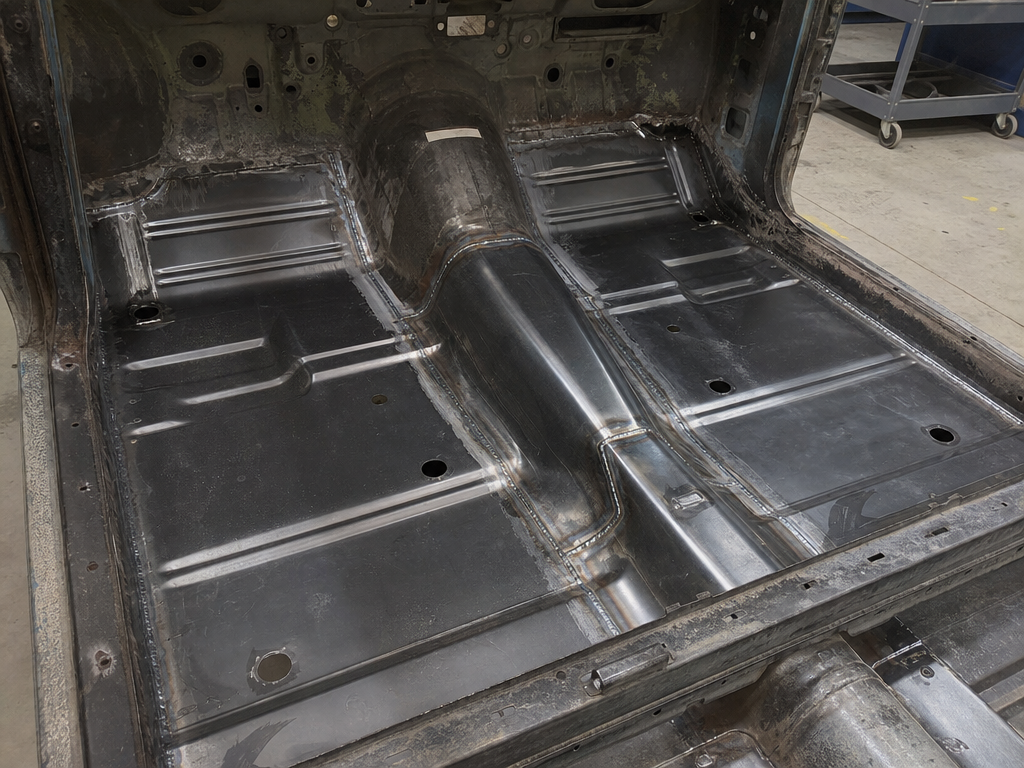
No fiberglass. No filler bridges. No tar.
Rust is the disease every Gulf Coast classic carries, and there is exactly one cure: cut it out and weld in good metal. Our fabrication bench repairs floors, quarters, frames, and the panels nobody reproduces — formed by hand when the catalog comes up empty.
Every shortcut in this trade eventually becomes our work order. Fiberglass mat over floor rot. Expanding foam in rocker panels. Roofing tar as undercoating, hiding the evidence. We've cut all of it out of cars that were "restored" a decade ago — so our position is not negotiable: rust gets removed to clean metal plus a margin, and it gets replaced with welded steel. Nothing else is repair. Everything else is concealment.
That margin matters. Rust you can see is the end of a process, not the start — perforation means the surrounding metal is thinned far beyond the visible hole. We cut back to steel that rings true, treat what remains, and weld in patch panels or full sections properly fitted, butt-welded, dressed, and sealed. Then we do the part that protects the repair for decades: cavity coating inside the enclosed sections where Houston humidity starts the next cycle.
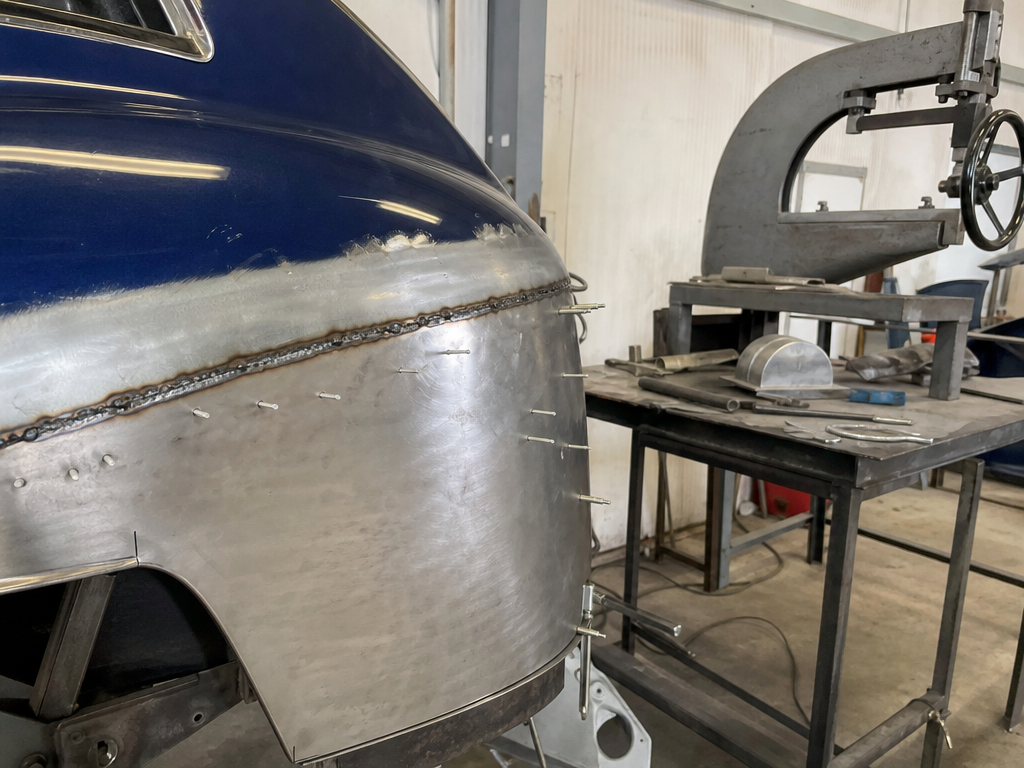
Structural and cosmetic metal repair: floor pans, trunk floors, rockers, cab corners, quarters, wheelhouses, cowls, frame rails, body mounts, and torque boxes. Replacement with stamped panels where good ones exist; hand-fabrication on the English wheel, bead roller, and shrinker-stretcher where they don't.
A car that's actually solid — not solid-looking. Doors that stop sagging because the hinge pillar is real again. Paint that stays flat because nothing is moving or blooming underneath it. And on unibody cars, the structural integrity that steering, braking, and crash safety silently depend on.
Some cars are too far gone for their value, and we'll say so with photographs instead of taking your money. When more than half the structure needs replacement on a common-spec car, the honest advice is often a better starting body — and we'll help you evaluate one before you buy it.
Discovery comes first: media blasting or stripping reveals the true map, and we photograph everything before cutting — you see the same rot we see, which is how trust survives a big metal bill. Then triage, panel by panel: repair the original steel where it's the better panel (it often is — factory stampings fit), install stamped reproduction where quality allows, fabricate from flat stock where nobody makes the part. Inner structures on trucks and X-frame cars are fabrication territory almost every time.
Welding standards are the difference between metal repair and metal damage. Butt welds with TIG or carefully pulsed MIG, planished and dressed — not overlapped flanges that trap moisture and telegraph a line through paint in two years. Structural sections are plug-welded on factory spacing, seam-sealed, and finished so the repair disappears into the car. Frame and unibody work gets measured against factory dimension specs, because a floor that's welded in crooked makes every panel above it fight.
Metal work is sequenced early in our build process for a reason: everything else stacks on it. It's the foundation stage of every frame-off restoration we do, and the prerequisite our body and paint shop refuses to work without.
Fifty years of design experience taught the factories nothing about drainage. These are the spots we check first — and the spots sellers hope you won't.
The classic-car widow-maker: leaves and water sit in the cowl plenum for decades, rot the channel, and leak onto the floors. Invisible until the headliner stains or the carpet stays wet — repair means surgery, and we do it right.
The structure. Convertibles and unibody cars depend on these boxes for stiffness, and they rot from the inside where undercoating hid the first decade of damage. This is the difference between a solid car and a flexing one.
Every classic pickup rusts here — double-walled sections that trap Gulf moisture permanently. Cab corners, steps, and inner cab supports are bread-and-butter fabrication on the trucks we restore.
Vinyl roofs hold moisture against steel for decades. We've pulled tops off "rust-free" cars and found the roof skin perforated. If your car wears vinyl, budget a contingency — and be suspicious of any seller who won't let you look underneath.
People think of rust as a northern, road-salt problem. Houston's version is quieter and, in some ways, worse — because it works where you can't see it.
Our air sits above 70 percent humidity most of the year, and every enclosed section of a car — rockers, frame rails, doors, quarters — breathes that air and condenses it nightly. Steel inside those cavities stays damp for hours every single day. Northern cars rust where salt hits them; Gulf cars rust everywhere air reaches, from the inside out, which is why a Houston car can show perfect paint over perforated rockers.
Closer to the water it accelerates: salt air from the bay side — Baytown, League City, Pasadena — deposits chlorides that make the corrosion cell dramatically more aggressive. And un-climatized garage storage barely helps, because the humidity comes inside too. A car parked for fifteen years in a Conroe barn rusts almost as enthusiastically as one parked outdoors.
The defense is the repair standard: welded steel, seam sealer, epoxy, and — the step that actually breaks the cycle — cavity wax injected into every enclosed section. If you're shopping for a project and want to know what you're really buying, our guide to spotting hidden rust before you buy covers the inspection routine we use ourselves.
The heaviest metal work in our shop shows up on trucks and unibodies — F-100 cab corners and Nova floors and subframe mounts are practically a house specialty at this point.
Blast or strip to bare metal; photograph and map every repair the car actually needs.
Remove rot to clean steel plus margin; verify structure against factory dimensions.
Source or fabricate panels; test-fit until gaps and contours match the factory line.
Butt-weld, planish, and dress until the repair disappears; seal every seam.
Epoxy same-day, cavity wax in enclosed sections, and photos into the build record.
You don't — not from the surface, and honestly neither do we until stripping. What we can do is a magnet-and-borescope assessment that catches most concealment, then give you a range with a contingency instead of a fantasy number. The real map appears at bare metal, and you'll see every photo.
Yes — that's the fabrication half of this bench. Inner structures, truck cab sections, trunk drops, and orphan-make panels get formed in-house from flat stock using the English wheel, bead roller, and hand tools. If steel once existed in that shape, we can make it again.
Often better. A well-executed butt-welded patch preserves original factory steel and fit, while a full reproduction quarter can mean fighting tolerances across the whole panel. We choose per panel based on how far the rot runs — and we'll show you the reasoning, not just the invoice.
Not if the repair breaks the cycle: welded steel, epoxy, seam sealer, cavity wax, and open drain paths. Rust returns when concealment was sold as repair. Our metal work outlives the paint on top of it.
Yes. Plenty of owners bring us structurally honest work — floors, rockers, cab corners — while keeping the rest of the project in their own garage. We'll return the car welded, sealed, and primed, ready for whatever comes next.
From bay-side salt-air cars to barn finds out of Conroe and Richmond, rust work comes to us from the whole metro — usually on a trailer, always welcome.
Send photos of the trouble spots — or bring the whole car. We'll map what's real, quote it honestly, and repair it in a way you'll never have to think about again.
(713) 555-0180