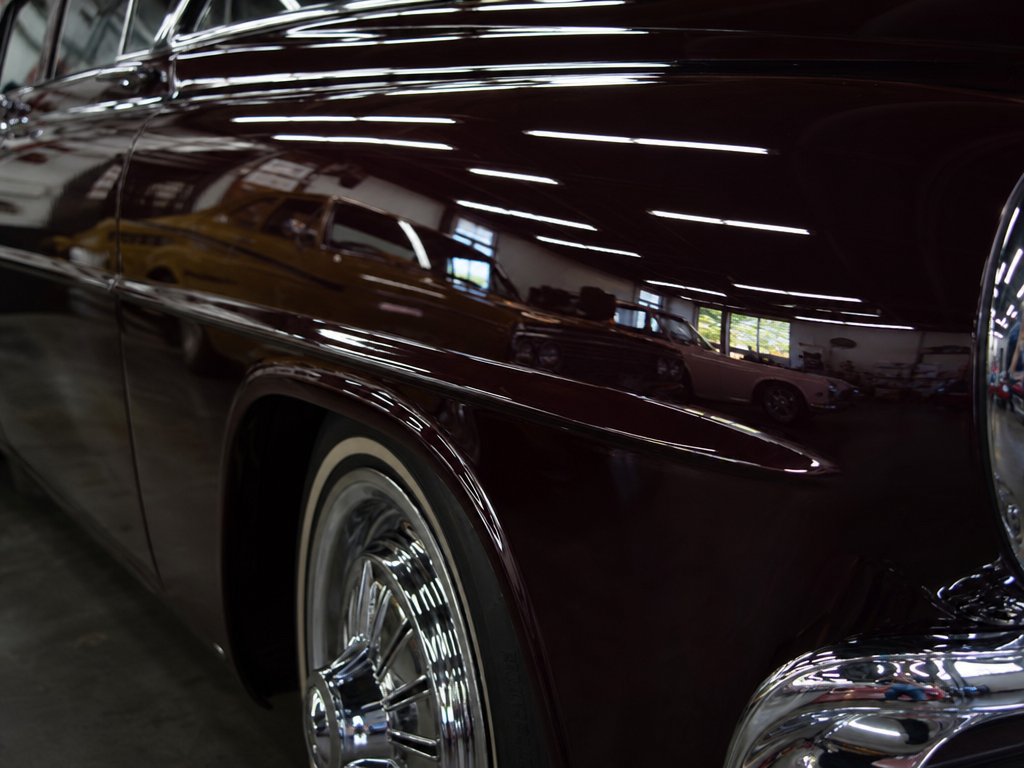
Metal first. Filler last. Always.
Paint is the most visible thing on a restored car and the least honest, because it covers everything done before it. Our rule is absolute: the finish is only allowed to be as good as the metal underneath it — so we get the metal right first.
Every week someone brings us a car with beautiful two-year-old paint that's bubbling at the wheel arches. The paint didn't fail. The preparation failed — filler over rust, primer over bare metal that flash-rusted overnight, a rushed booth schedule. Paint is chemistry, and chemistry doesn't forgive shortcuts.
So we hold a position that costs us jobs from impatient customers and wins us everything else: bodywork is finished when the panel is straight in bare metal, not when enough filler makes it look straight. Our benchmark is filler measured in millimeters, used as a skim coat — not sculpting material. If a quarter panel needs steel, it goes to our rust repair and metal fabrication bench before it ever sees primer.
If you want to understand what happens when shops skip this — and how to spot it when buying a restored car — we wrote it up plainly in why cheap paint fails on a restored car.
Complete body restoration: panel repair and replacement, gap setting, metal finishing, epoxy sealing, high-build and block sanding cycles, and base/clear or single-stage paint sprayed in our climate-controlled in-house booth. Color-sanded and buffed to the level the car calls for — driver, show, or concours.
Panels that read straight down the side in raking light. Factory-correct gaps that most of these cars never had even when new. Color matched to the original code — or a deliberate change done so thoroughly (jambs, firewall, underside) that it never looks like a repaint.
We don't do insurance collision work, and we don't do "scuff and shoot" repaints over unknown substrates — that's renting a finish, not owning one. If your existing paint is fundamentally sound and just tired, honest news: you may only need paint correction, and we'll tell you so.
Bodywork begins with the car stripped — chemically or media-blasted depending on the panel — because sanding through old paint tells you nothing about what's underneath it. With bare steel in front of us, we metal-finish: shrinking stretched panels, hammer-and-dolly work, replacing sections where repair would leave more filler than metal. Panel gaps get set now, with the actual hinges, latches, and fenders the car will wear, because paint thickness changes fitment and amateurs discover that too late.
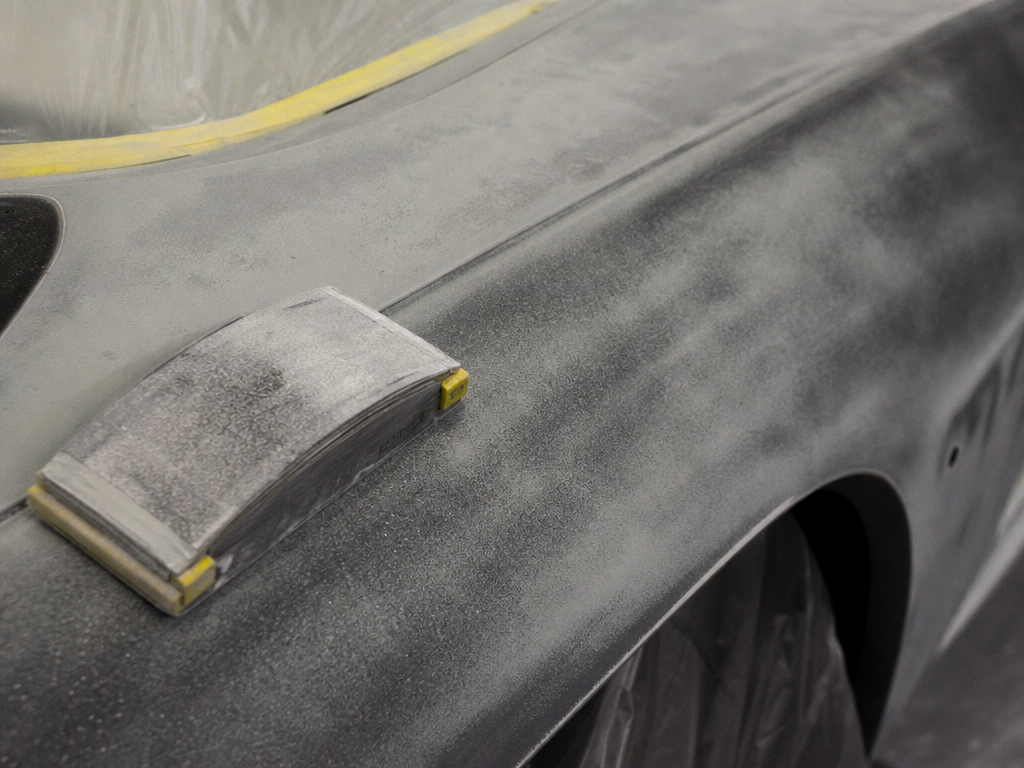
Then the part nobody sees and everybody notices: epoxy primer, high-build, and block sanding — guide coat after guide coat, 80 grit walking down to 400, until a straightedge and raking light agree the panel is flat. On a show car this cycle alone can be well over a hundred hours. It's the difference between paint that shines and paint that reflects.
Spray day is almost anticlimactic when prep is right. Base and clear go on in our own booth — never farmed out — with color verified against sprayed test cards, not a screen. Cut and buff finishes the job: 1500 through 3000 grit, compound, polish. Brightwork goes back on last, which is why paint and chrome and trim restoration are sequenced together on full builds.
Stripping a fifty-year-old car is archaeology. These are the layers we find most often.
Body lines rebuilt entirely from polyester filler — sometimes half an inch deep — over dents that were never metal-worked. It cracks, it shrinks, it prints through paint within a couple of Texas summers. All of it comes off; the metal gets fixed properly.
Kinked aprons, sectioned quarters, brazed seams from a 1970s wreck repair. We find it at bare metal, document it, and fix what matters structurally — and you finally learn the car's real history.
Wheel arches, lower quarters, door skins, cowl vents, window channels. Surface bubbles are the visible ten percent. The repair is steel, welded and finished — never fiberglass mat and hope.
Lacquer over enamel over lacquer — a chemistry stack that wrinkles or delaminates the day fresh material hits it. It's the single biggest reason we strip rather than sand and re-shoot.
Houston is brutal on paint from both directions — UV from above, moisture from below. We build the finish for this climate specifically.
The sun first: Gulf Coast UV load fades single-stage reds and burns through thin clear faster than almost anywhere in the country. We spray premium two-stage systems with UV-stable clears at full recommended film build, and we tell every owner the truth about carports: a classic that lives outside here is a classic that will need paint again.
The humidity is sneakier. Bare metal flash-rusts in hours in our air, so panels never sit unprimed overnight in our shop — stripped steel gets epoxy the same day. Moisture also lives in unsealed seams and cavity sections, pushing bubbles up through fresh paint from behind. Our answer is the same one we apply on every frame-off restoration: seam sealer at factory locations, cavity wax inside enclosed sections, and drainage kept open so the body can shed the water this climate guarantees it will see.
Salt air matters too — cars from Baytown, League City, and the bay communities carry chloride contamination that will lift paint if it isn't chemically cleaned before primer. Panel prep here includes decontamination steps that shops in dry states genuinely never think about.
A "ten-footer" looks great from ten feet. Here's what closes that distance.
The gap shows most on cars with big flat panels and factory two-tones — Impalas and Bel Airs are merciless in raking light — and on Mopar high-impact colors, where a Charger in Plum Crazy either glows or looks like a toy. There's no middle.
Scope agreed, then chemical strip or media blast to bare steel. No unknowns left under the finish.
Repair, replace, and metal-finish panels; set every gap with real hardware installed.
Epoxy, high-build, and guide-coat blocking cycles until raking light shows a flat, straight body.
Base and clear in our in-house booth, color verified on sprayed cards and signed off by you.
Color sand, compound, polish; final inspection under show lighting before reassembly begins.
They're different products entirely. A commodity repaint covers a car; restoration paint work rebuilds the body it sits on. The majority of our hours go into metal and blocking — which is exactly the work a cheap quote skips. We scope every car individually after seeing it in person.
Yes. We work from the factory paint code on your trim tag, spray physical test cards, and check them in natural light against preserved original paint where the car still has any. You approve the match before we commit the body.
For investment and show cars, original color protects value — judges and buyers check the code. For a personal driver, it's your car and your call; we just insist on doing a color change completely, including jambs, firewall, and underside, so it never reads as a repaint.
Rarely, and only after we've inspected the substrate ourselves. Our name goes on the finish, so we won't spray over another shop's unknown prep. If the bodywork checks out under inspection, we'll quote it honestly.
A straight car needing cosmetic body and paint typically runs 3 to 5 months. Cars needing significant metal replacement run longer — and we'd rather tell you that at assessment than discover it together at month four.
Show-quality paint is worth a drive — and our clients prove it weekly, trailering cars in from every corner of the metro. Wherever the car sits today, we can talk logistics.
Bring us the car — or photos to start. We'll tell you what the body actually needs, what it doesn't, and what honest show-quality work involves.
(713) 555-0180