If you can spot the upgrade, we did it wrong.
A restomod done right looks like the car the factory would have built with today's parts bin. Fuel injection, real brakes, suspension that tracks straight at 75 — integrated so cleanly that the car still reads original until you drive it.
The restomod world has a loudness problem. Billet everything, digital dashes glowing like a casino, fender flares over rubber-band tires. That's not what we build. Our conviction: the highest form of the craft is restraint — a car that looks period-correct at a show and then embarrasses modern traffic on the drive home.
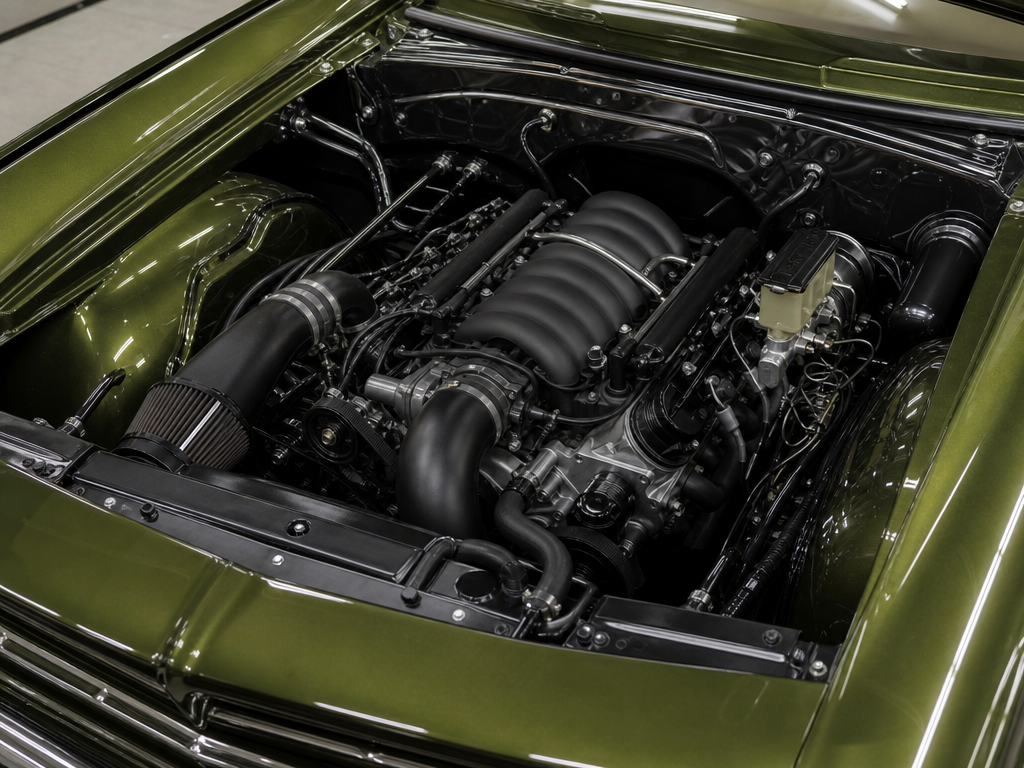
That philosophy drives real engineering choices. Wiring routed where the factory routed it. EFI hidden under a period air cleaner. Disc brakes behind correct-style wheels. A/C vents that use factory bezel locations. Every modern system is chosen for how invisibly it integrates, not for how impressive it looks on an invoice. If you're still deciding whether to modify at all, read our honest breakdown of restomod vs. numbers-matching — some cars deserve to stay factory, and we'll tell you when yours is one of them.
A full restoration plus modern systems: LS, Coyote, or Hemi crate power (or injected original-family engines), overdrive transmissions, four-wheel disc brakes, upgraded suspension geometry, modern wiring, A/C, and sound insulation — engineered as one coherent car, not a parts pile.
A classic you actually drive: cold A/C in August, 70-mph cruising at 2,100 rpm, brakes that stop straight in a panic, and cold starts every time. Restomods get driven ten times more than concours cars — that's the whole argument for them.
We don't build show-circuit customs, tube-chassis race cars, or meme builds. And we won't restomod a rare numbers-matching car without a serious conversation first — some cars are historical documents, and cutting one up is a decision you can't buy back.
Every restomod starts as a restoration — the same teardown, rust repair, and body discipline as any of our builds, following the same documented process. Modern parts bolted to a rotten shell is the most expensive mistake in this hobby, so the foundation comes first, always.
Drivetrain is engineered as a system: engine, transmission, rear gear, cooling, fuel delivery, and exhaust chosen together. An LS3 with a 6-speed needs a fuel system, driveshaft, and rear end rated for it — and a radiator package that can idle through a Houston August with the A/C on. Our engine and drivetrain bench handles the mechanical package in-house, mounts and crossmembers fabricated to keep everything serviceable.
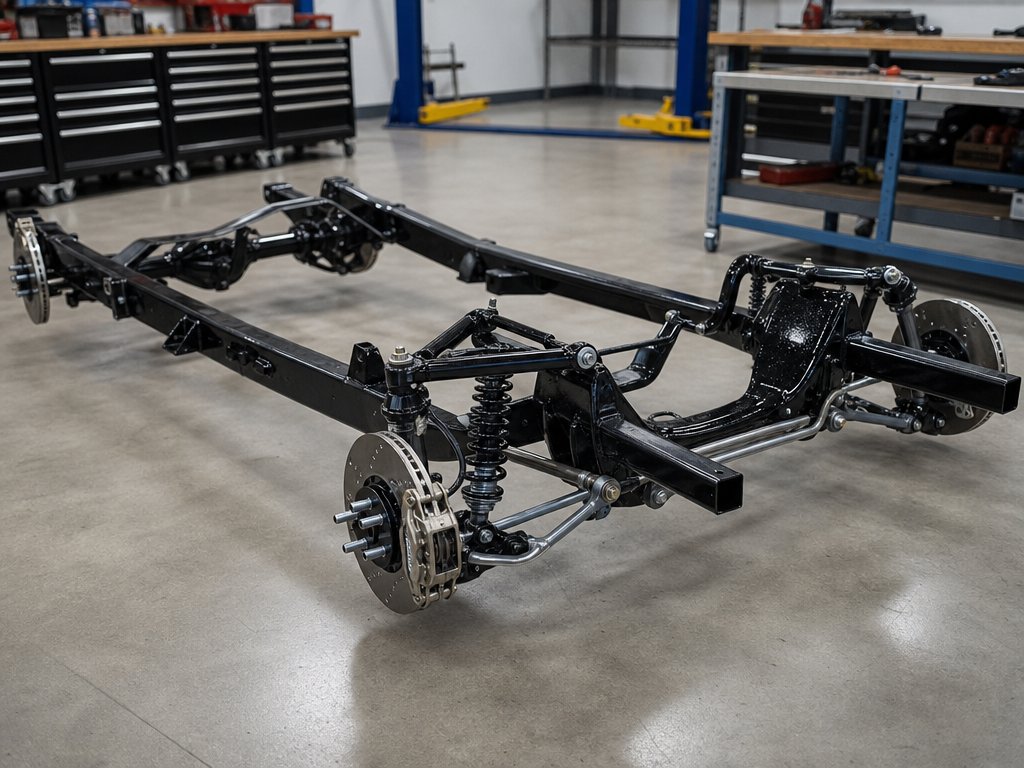
Chassis work makes the power usable: tubular control arms, correct spring rates, sway bars, and four-wheel discs specified through our brake and suspension upgrade program — matched to how you'll drive, not to a catalog photo. And underneath it all runs a modern harness from our wiring and electrical bench: labeled, fused, relay-protected, and routed factory-style, because electrical integration is where most restomods quietly fail.
A meaningful share of our restomod work is rescuing builds that started somewhere else. The same failures show up again and again.
A 500-horsepower crate engine feeding four-decade-old drum brakes and worn bushings. It's genuinely dangerous. Brakes, suspension, and tires get engineered to the power level in every build we deliver — non-negotiable.
Universal fuse panels spliced into original harnesses, grounds through rusty sheet metal, EFI systems chasing voltage drops. Electrical gremlins kill more restomod projects than any mechanical failure — we rewire properly rather than patch.
Modern engines make modern heat. The stock-size radiator that "worked fine" in October overheats in stop-and-go on Westheimer in July. Cooling packages get sized for worst-case Houston, then verified with real data.
EFI grafted onto a vented tank with a rubber-hose feed and no return. Injection needs correct in-tank pumps, lines, and regulation — we build the whole system, not just the throttle body everyone sees.
We'll say something unfashionable: Houston is a restomod city, and the climate is the reason.
A carbureted classic with no A/C is a car you drive eight weekends a year here. The heat index makes summer cruising miserable, stop-and-go traffic pushes marginal cooling systems over the edge, and hot-soak restarts plague carburetors fighting modern ethanol blends. A properly built restomod erases all three problems — EFI meters fuel correctly regardless of heat soak, modern cooling handles the idle load, and integrated A/C makes July a driving month instead of a storage month.
The climate also argues for the electrical and rubber upgrades: Gulf humidity corrodes fifty-year-old connectors and bulkhead terminals from the inside, while modern sealed connectors shrug it off. Ethanol-rated fuel lines don't soften and weep the way original-spec rubber does. Even the sun gets a vote — modern insulation under the roof skin and floor drops cabin temps enough to notice before the A/C ever switches on.
Build it right and you get the best of both: a car that looks like 1969 and commutes like 2026, whether it's headed to Cars & Coffee in Katy or across the state on I-10.
Platform matters: first-gen Camaros and El Caminos take modern running gear beautifully, and early Broncos might be the single best restomod platform ever built. We'll tell you what your platform takes well — and what it fights.
How you'll drive it decides everything — cruiser, canyon car, long-hauler. We spec to the mission.
Teardown, rust repair, and body restoration first. Modern parts never go on a compromised shell.
Drivetrain, chassis, wiring, cooling, and climate installed and integrated as one engineered package.
Real shakedown miles — tuning, alignment, and punch-listing until the car drives like it should.
Keys plus full documentation: wiring diagrams, build specs, and the photo record of everything.
It depends on the car. Common-spec cars often gain value restomodded — buyers pay for drivability. Rare, numbers-matching cars usually lose collector value when modified, and we'll tell you before you commit. Either way, we keep original components so the car can be returned to stock.
Largely, yes. We favor bolt-in systems over cutting, label and crate every original part we remove, and document the changes. Full reversibility isn't always possible — some swaps require modification — but we engineer to keep doors open.
Both are valid and we build both. An LS gives the best power, economy, and parts support. An injected original-family engine keeps the car's sound and underhood identity. The deciding factors are budget, originality feelings, and how far you'll drive it — we'll walk you through the honest tradeoffs.
More than a stock restoration of the same car — the systems and engineering hours are additive. Scope drives everything: platform, power level, and how deep the foundation work goes. We quote from an in-person assessment, in writing, with the drivetrain package itemized.
Usually, yes — it's a big part of our intake. We audit what's there, tell you plainly what's salvageable and what has to be redone, and quote the completion honestly. Sometimes the news is good. We'll give it to you straight either way.
Restomod clients come to us from every side of the metro — usually after seeing one of our builds at a local show and realizing it wasn't a stock car. Wherever yours is parked, the conversation starts the same way.
Tell us the car and how you want to use it. We'll spec a restomod package that fits the mission — and tell you honestly if your car shouldn't be modified at all.
(713) 555-0180