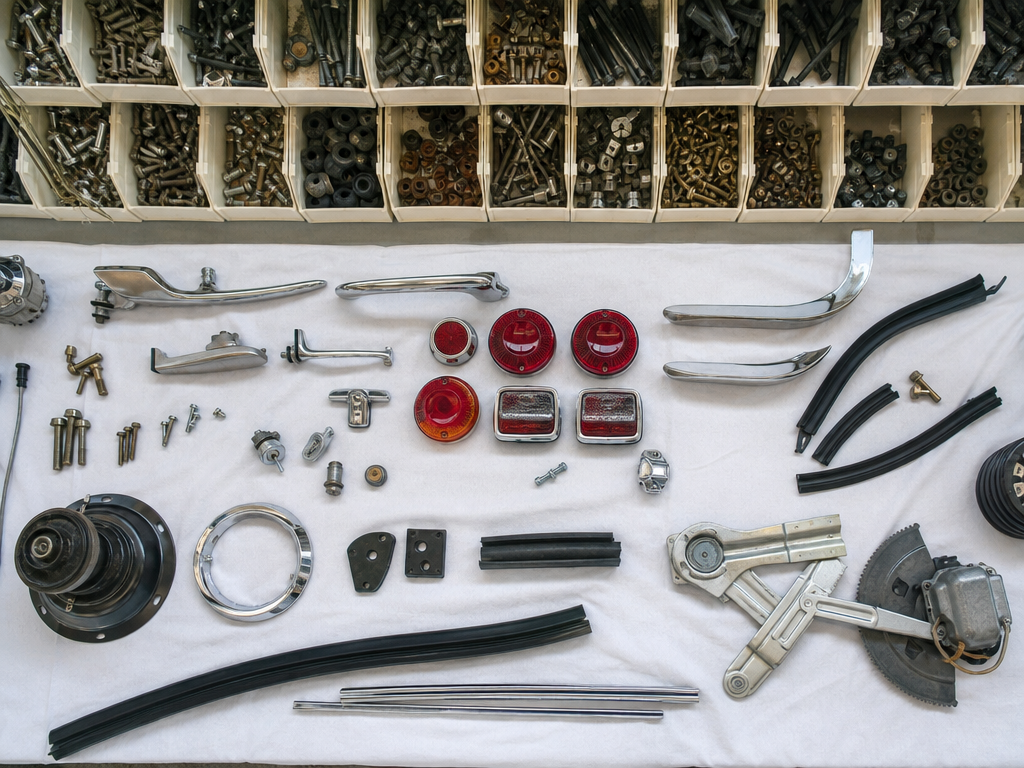
Every bolt off. Every decision documented.
We believe there's no such thing as a partial frame-off. Either the body comes off the frame and every system gets assessed on its own merits, or you're paying restoration money for repair work. Our shop takes the car all the way down — and shows you everything we find.
We've spent 18 years watching Houston cars come into our shop wearing someone else's shortcuts. Paint over filler. Filler over rust. Rust over a frame that was never inspected because taking the body off was "too much." So here's where we stand: if the body doesn't come off the frame, you don't actually know what you own.
A frame-off restoration is the only process that lets us make every decision with full information. When the body is on a rotisserie and the chassis is stripped to bare steel, nothing hides. Not the pitted frame rail behind the rear kick-up, not the cracked body mount, not the previous owner's brazed-in patch panel. That transparency is the whole point — it's why the finished car is worth more, drives better, and doesn't surprise you three summers from now.
That's a hard line, and we hold it because we're the ones who have to stand behind the car when it's done. Every frame-off we deliver follows the same documented build process — assessment, teardown, metal, mechanicals, paint, assembly — with photographs at every stage.
"Frame-off" gets used loosely in this industry. Here's what it means inside our shop, so you can compare quotes on equal terms.
Complete disassembly: body off the frame, every component removed, catalogued, and photographed. The chassis is stripped, inspected, and refinished. Every system — engine, driveline, brakes, suspension, wiring, interior, brightwork — is restored to spec or replaced with correct parts. Then the car is reassembled in the right order, under one roof.
Full knowledge of the car's true condition. Correct repairs instead of cover-ups. A rust-free foundation that protects the paint investment. Documentation that materially supports appraisal value and resale. And a car that drives the way it was engineered to — because the chassis, not just the paint, was done right.
A frame-off is not always the right call, and we'll tell you when it isn't. A solid, original survivor may deserve preservation, not restoration. A tired driver may only need mechanical work. If your goals and budget point to a partial restoration, we'd rather scope that honestly than sell you a teardown you don't need.
Teardown comes first, and it's slower than most owners expect — deliberately. Every fastener, bracket, and clip goes into a labeled, photographed inventory before anything is cleaned. That catalog is what makes reassembly accurate two hundred hours later, and it's what protects date-coded and numbers-matching components from being lost or mixed.
With the body on the rotisserie, we media-blast to bare metal and map every repair the car actually needs. Structural work happens now: frame repair, body mounts, floor pans, trunk pans, quarters — all of it handled by our rust repair and metal fabrication bench before a drop of primer goes on. Mechanical systems run in parallel: the drivetrain goes to our engine room for a complete engine and drivetrain rebuild, while suspension, steering, and brake components are rebuilt or replaced with correct-spec parts.
Only when the metal is right does the shell move into body and paint — gaps set, panels blocked, color matched to the car's original code or your chosen finish. Final assembly is sequenced so that nothing installed early has to come back off: chassis first, driveline, body, wiring, glass, interior, brightwork. Then we drive it. Every finished frame-off gets road miles and a punch-list shakedown before delivery.
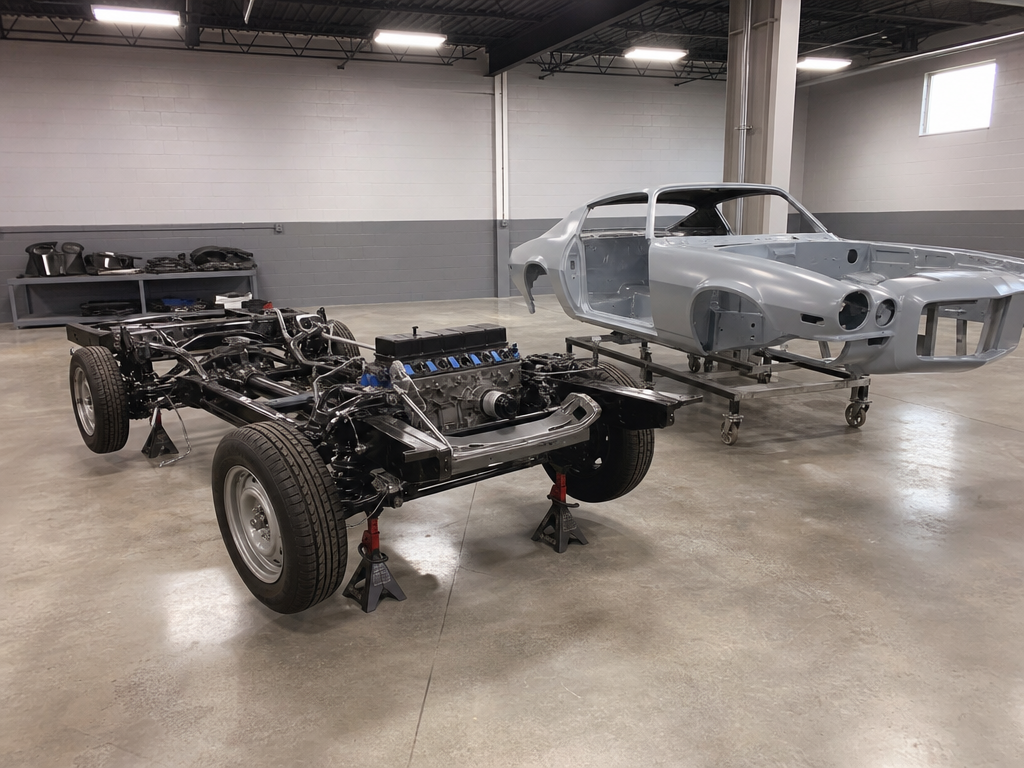
Roughly nine out of ten cars we take down reveal something the owner didn't know about. These are the usual suspects — and why catching them at teardown is so much cheaper than catching them after paint.
Frame kick-ups, body mounts, torque boxes, and inner rockers rot from the inside out. On the surface the car looks solid; under blasting, the steel is lace. We repair with fabricated or stamped replacement sections welded to factory standards — never patched over.
Body filler an inch deep, brazed patches, house-paint undercoating hiding rot, wrong-era hardware. Undoing bad work is a real cost on many projects, and we document every instance we find so you know exactly what you paid to fix.
Fifty-year-old bushings, leaf springs, kingpins, and wheel bearings don't announce themselves — they just make the car drive vague and unsafe. A frame-off is the only time replacing all of it is efficient, because it's all already apart.
Wrong carburetors, swapped rear ends, replacement blocks with mismatched casting dates. We verify numbers and date codes during cataloguing and tell you what's correct, what's period-plausible, and what's wrong — before you decide how far to take authenticity.
Houston is one of the hardest climates in America to own a classic car in — and most of the damage happens where you can't see it.
Gulf humidity sits above 70 percent most of the year, and it condenses inside frame rails, rocker panels, and door bottoms every single night. Cars that spent their lives within reach of the coast — Baytown, League City, Galveston Bay communities — carry salt air corrosion that works from the inside of box sections outward. By the time rust bubbles through paint, the structural steel behind it has usually been compromised for years. That's why we blast and inspect every enclosed section during a frame-off instead of trusting what the surface shows.
Texas sun does its own damage: dashboards split, lacquer checks and dies, and rubber weatherstrip bakes hard, letting water into the body seams it was supposed to protect. And the storage problem is real — a classic that's been sitting in an un-climatized Houston garage for a decade almost always has ethanol-degraded fuel lines, varnished tanks, and corroded carburetor internals, because E10 gasoline absorbs moisture and turns acidic as it ages. We see it constantly, which is why fuel systems get fully rebuilt, not just flushed, in every frame-off we do.
The upside: a car restored correctly for this climate — proper cavity coatings, modern seam sealers, correct drainage — survives Houston beautifully. That's the standard we build to.
The two cars can look identical on delivery day. Give them three years — that's when the difference shows up.
If you're weighing what that gap costs in real dollars, we wrote an honest breakdown: what a frame-off restoration actually costs — including the parts of the estimate other shops leave out.
Parts strategy is a judgment call we make with you, panel by panel and system by system — but our defaults are firm.
We look at the car together, talk goals — driver, show, investment — and scope the build honestly.
Complete disassembly with every component photographed and catalogued. You see everything we find.
Metal, mechanical, body, paint — sequenced so nothing gets redone, documented at every stage.
Assembly checks, fluid and electrical verification, then real road miles before we call it finished.
You get the car, the complete photo record, and a shop that answers the phone afterward.
Wondering which platforms we take down to the frame most often? First-generation Camaros and 1964½–73 Mustangs lead the list — but the process is the same for every era we restore.
Most of our frame-off builds run 12 to 18 months. Heavy rust repair, rare-parts sourcing, or concours-level finish work can extend that. We set the timeline honestly at assessment and update you at every stage — no strung-along surprises.
Frame-on (or "cosmetic") restoration refreshes the car without separating body from chassis, so enclosed structures never get inspected. Frame-off removes the body completely, which is the only way to verify and restore the car's actual foundation. For unibody cars like Mustangs and Novas, the equivalent is a full rotisserie restoration.
Sometimes no — and we'll say so. If the car has major sentimental or market value, hidden rust, or you plan to keep it long-term, frame-off is usually the right investment. If it's a solid driver you just want to enjoy, a targeted mechanical and cosmetic scope may serve you better. The assessment tells us which.
No — done correctly it protects it. We identify, tag, and preserve date-coded components during teardown, rebuild original assemblies rather than swapping them, and document the whole chain. Provenance survives our process; it rarely survives a careless one.
Yes — we encourage it. You'll get stage photographs throughout, and shop visits are welcome by appointment. It's your car; you should never wonder what's happening to it.
Frame-off projects come to us from every corner of the metro — and we arrange enclosed transport when the car isn't ready to drive. Wherever it's parked, the first step is a conversation.
We take on a limited number of frame-off restorations each year, because each one gets the hours it deserves. If your car is worth doing, it's worth doing once.
(713) 555-0180