Sixty-year-old brakes were adequate in 1965.
We believe the least glamorous money in a restoration is the most important: the systems that steer and stop the car. Whether that means a factory-correct rebuild or a modern disc and geometry package, we make classics drive the way their owners remember — which is usually better than they actually did.
There's a car in every cruise night lineup with $40,000 of paint and four drum brakes full of 1972. We think that's backwards. Our conviction: the chassis is the car — paint is what the car wears. A classic that wanders, dives, and needs a football field to stop isn't preserving history; it's just deferring maintenance in public.
That doesn't automatically mean modernizing. A correctly rebuilt factory system — fresh kingpins or ball joints, arced springs, properly adjusted drums, a rebuilt steering box — transforms most classics on its own, because almost nobody driving these cars has ever felt one with zero worn parts. We rebuild to factory spec beautifully. But when an owner drives Houston freeways among distracted commuters in 4,000-pound SUVs, we'll say plainly: front discs and a dual-circuit master cylinder are the cheapest life insurance in the hobby.
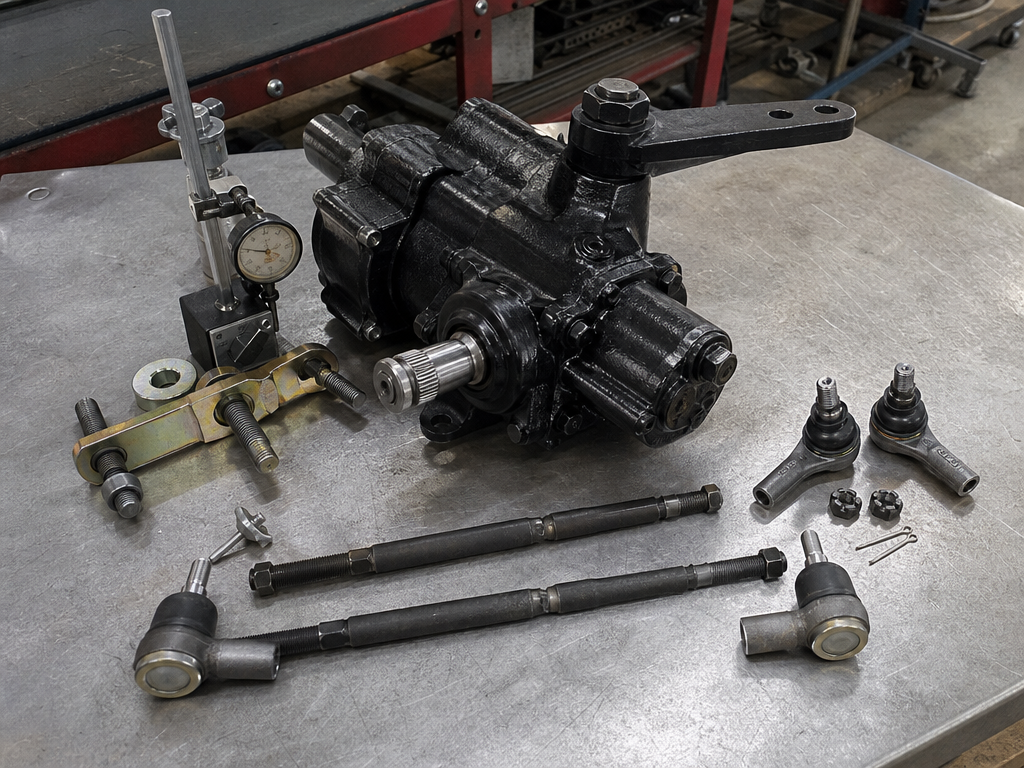
Factory-spec rebuilds and staged upgrades: drum service and disc conversions, dual-circuit master cylinders and boosters, stainless lines, rebuilt steering boxes and linkages, springs, shocks, bushings, sway bars, and full geometry packages with tubular arms and coilovers where the build calls for them. Finished with a proper alignment.
A classic you trust at 70 mph. Braking that doesn't require planning. Steering with a center. A ride that absorbs Houston's pavement instead of reporting it. And confidence for the family members who ride along — which, owners tell us, is what finally gets the car driven.
We don't do slammed-on-air show stances that ruin geometry, and we won't install parts that outclass the car's structure — 6-piston calipers on a rotten frame is theater. Structure first (that's a frame-off conversation), then the chassis package that structure can carry.
Every chassis job starts with a full inspection on the lift: play measured at every joint, springs checked against ride-height spec, frame and mounting points verified sound. Fifty-year-old cars hide worn idler arms inside worn tie rods inside worn control-arm bushings — replacing one and skipping the rest is why "I just had that fixed" cars still wander.
Brake work runs from correct restoration to full conversion. Factory rebuilds get new wheel cylinders, hardware, arced shoes, and turned drums within spec. Conversions get engineered as systems: rotor size matched to wheel clearance, correct master cylinder bore and pushrod geometry, proportioning set to the car's actual weight balance, and a firm, progressive pedal — not the grabby, over-boosted mess kit-in-a-box conversions deliver. Power steering boxes are rebuilt or swapped to quicker-ratio units that keep period appearance.
Suspension follows the car's mission. Stock-plus builds get quality rubber or poly bushings, correct-rate springs, and matched shocks. Performance builds — usually alongside a restomod drivetrain from our engine and drivetrain bench — get tubular arms, corrected roll centers, and sway bars sized front-to-rear so the car rotates instead of plowing. Every job ends on the alignment rack with modern-radial specs, not the bias-ply numbers in the factory manual.
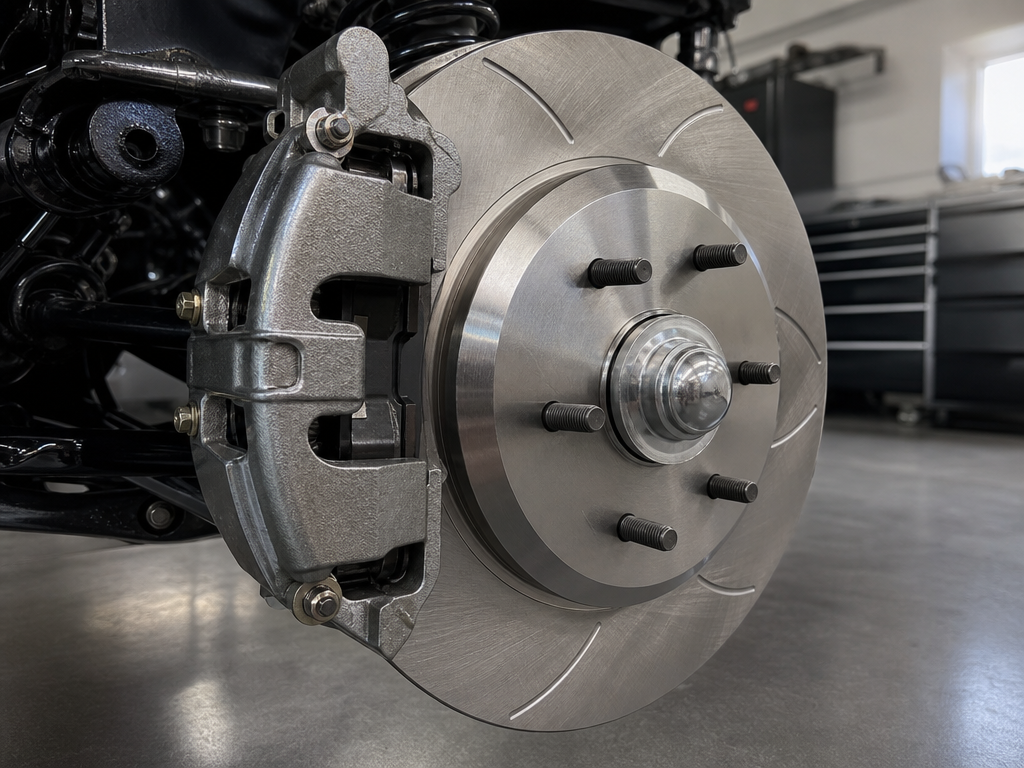
Pre-1967 single-reservoir systems lose the whole car when one line fails — and the lines are fifty years old. A dual-circuit master and fresh hard lines is the first upgrade we recommend on any driver, period-appearance preserved.
Brake fluid absorbs Gulf moisture; decades of it leaves rusty soup, pitted cylinders, and seized adjusters. If the fluid looks like coffee, the system behind it looks worse. Full hydraulic renewal, not a bleed-and-hope.
Every bushing, body mount, and spring isolator has been aging since the Nixon administration. Dead rubber is why restored cars still rattle and wander — and why our chassis packages replace all of it, not the visible half.
Disc kits with mismatched master bores, no proportioning, hoses rubbing frame rails, spacers stacking wheels into fenders. We re-engineer more bad conversions than we install new ones — buy it once or buy it twice.
Where the car lives should shape how it's built. Houston makes two specific arguments to us daily.
The first is traffic physics. These cars were engineered for 1960s speeds and 1960s following distances; a Sunday drive today means 75 mph on I-10 between drivers reading their phones. Emergency-stop capability isn't nostalgia-optional here — it's why our disc-conversion conversation is more direct with Houston commuline drivers than it would be with someone cruising farm roads twice a year.
The second is moisture. Hygroscopic brake fluid pulls Gulf humidity through every seal and breather until wheel cylinders pit and lines rot from the inside — a parked car's brake system ages here even at zero miles. Same story for chassis lubrication: grease dries, water finds kingpins and wheel bearings, and un-driven cars seize their own hardware. Our spec answers the climate: DOT 4 on fresh systems, stainless hard lines on coastal-side cars from Baytown to League City, sealed bearings where originality allows, and marine-grade grease where it doesn't.
And Houston pavement deserves a mention: expansion joints and patch seams that make dead shocks and worn bushings feel twice as bad. Owners always tell us the car "rides like new" after chassis renewal. It actually rides better than new — the roads demanded it.
Platform knowledge does the heavy lifting: GM A-bodies like the GTO respond enormously to modest geometry work, while early Broncos need steering and track-bar discipline before anything else. We spec by platform, not by catalog page.
Every chassis package is documented in the same build record as the rest of our restoration process — torque specs, part numbers, and alignment printout included.
Full chassis measurement on the lift — every joint, spring, line, and mounting point, in writing.
Factory rebuild or staged upgrade, matched to how and where you actually drive the car.
Hydraulics, steering, springs, and geometry installed as one system — no orphan parts.
Modern-radial alignment specs, brake bias verified on the road, ride height documented.
Road-tested and signed off — stops straight, tracks true, settles flat. Every time.
On most driver-grade classics, no — buyers increasingly expect it, and we keep period appearance behind factory-style wheels. On rare, judged, numbers-matching cars we'll advise keeping the original system rebuilt to spec, and we box every factory part we remove either way.
Properly rebuilt drums with a dual-circuit master stop a classic acceptably for light use — we rebuild them to that standard often. Regular freeway driving, hills, or towing tips the math toward front discs. We'll give you our honest read for your car and your miles.
Usually stacked tolerances: a worn steering box, tired idler arm, dead bushings, and 1960s alignment specs on modern radials — each "within limits," together a car with no center. Renewal plus a modern-spec alignment fixes what any single part swap can't.
Moderately, yes — an inch or so with correct-rate springs and matched shocks keeps geometry workable and looks right. Beyond that, geometry correction has to come along for the ride. We'll show you where the line is on your platform before you commit.
A full chassis renewal or conversion typically runs 2 to 4 weeks depending on parts and machine work. As part of a larger restoration it's sequenced while the body is elsewhere in the shop, adding little to the overall timeline.
Chassis work draws cars from all over the metro — often after one white-knuckle freeway merge too many. Drive it in if it's safe; we'll trailer it if it's not.
Tell us what the car does — wanders, pulls, dives, needs a prayer to stop — and we'll put it on the lift and show you exactly why.
(713) 555-0180